Get freedom from keeping track of statutory compliances
ComplySquare keeps every statutory obligation for every client in one place — derived from a maintained rulebook, dated under the rule that governs it, assigned to someone, and tracked until it is closed.
Deadlines you derive, not deadlines you type
Most compliance tools are a shared calendar with your deadlines typed into it. The typing is the problem: it is where a missed obligation comes from, and it has to happen again for every new client. ComplySquare works the other way round, in three layers.
1 · The rulebook
ComplySquare carries a maintained catalog of Indian statutory obligations — GST returns and payments, TDS and TCS, income-tax returns and advance tax, ROC filings and the rest. Each one carries its own periodicity, its own due-date rule, and the conditions that decide who it applies to. Your firm does not build it and does not maintain it. We do.2 · What applies to each client
You record what is true about a client — its type, its registrations, the facts that change year to year. ComplySquare derives that client’s own set of obligations from the rulebook. A private limited company with a GST registration and a TAN carries a different set from a charitable trust, and both sets change when the facts change.3 · What is due, and when
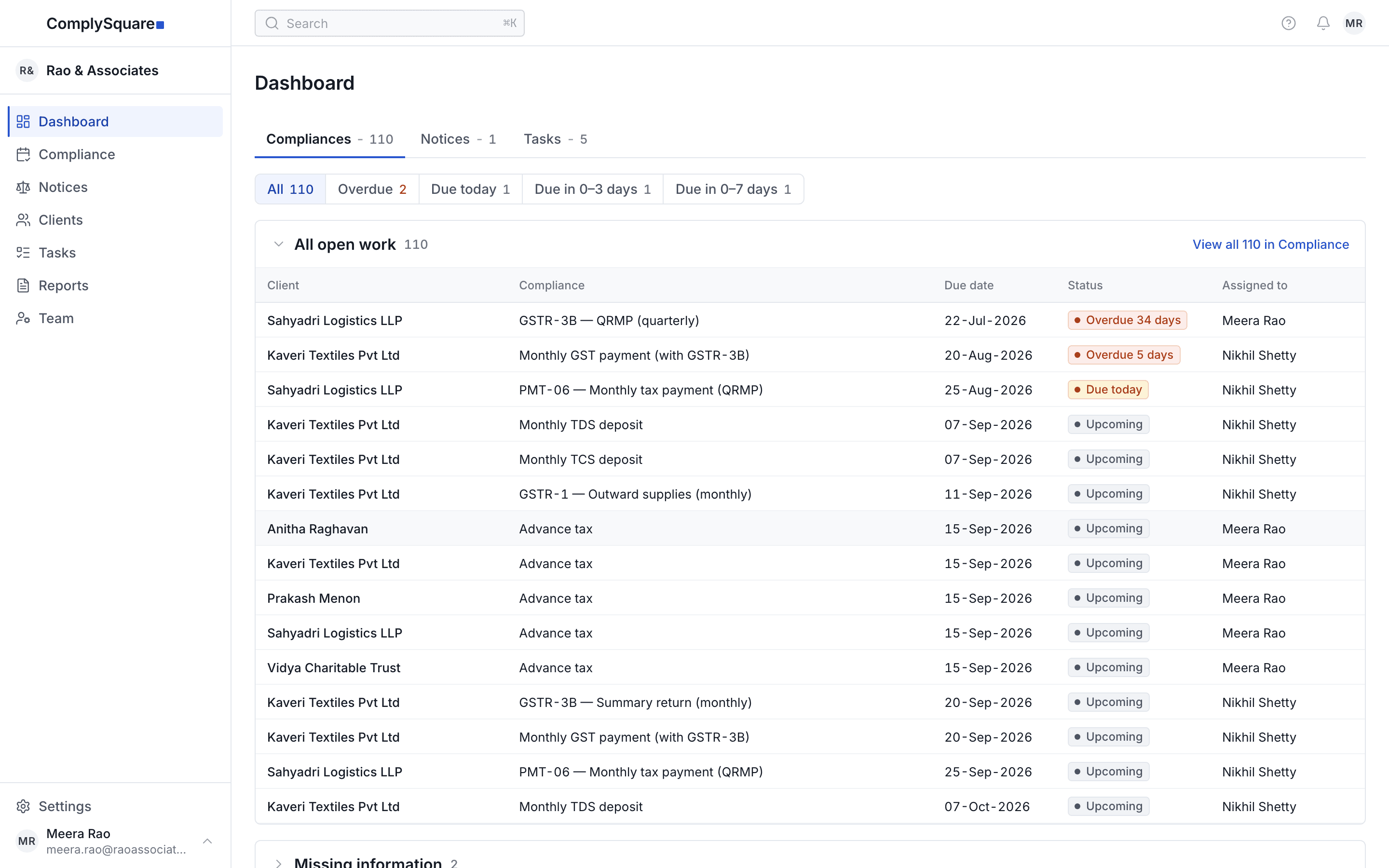
Every applicable obligation becomes a dated instance for each period it falls in, across the current financial year and the one before it. Each instance carries a due date computed under its rule, a status, and an assignee. Onboard a client and the current season’s backlog appears in full — because that backlog is real statutory work, and it was already yours.
Nobody types a due date. That is the difference.
What is in it
Six surfaces, one book. Everything below reads from the same client records and the same rulebook, so nothing has to be kept in step by hand.
Compliance tracker
One list for every category, filtered by financial year, period and type. Filed, pending or not applicable, with the whole history behind each row.
Clients and registrations
Companies, LLPs, partnerships, trusts and individuals, with their registrations, key people and per-year facts.
Notices and appeal chains
A notice becomes a proceeding, and the proceeding keeps its own timeline through AO, CIT(A), ITAT, High Court and Supreme Court.
Tasks
Ad-hoc work that is not a statutory filing, assigned and tracked beside the work that is.
Reports and exports
Pick an entity, filter it, choose your columns, take Excel or PDF. The row count is shown before the download starts.
Team and assignment
Partners and staff, who owns which client, and who sees what — enforced in the database, not in the interface.
Built like the work it tracks
ComplySquare is developed against a written design system, a documented access model, and a release gate that every change passes before it ships: the full test suites, static checks, an adversarial review, and a production smoke run after every deploy.
A statutory deadline is not a place for a tool that is probably right.
Where your clients’ data lives
In India. The database runs in Mumbai and each firm’s data is isolated in the database itself, not by application code. Each firm’s workspace is invite-only — public registration creates a new firm, never access to an existing one — and support access is time-limited and recorded in an audit log the firm can read.
See it against your own book
A demo runs on your clients and your obligations, not a sample dataset.
Or write to hello@leopathway.com.